How to Respond to an RFP: A Step-by-Step Guide for Small Contractors
· RFP response, Government contracts, Bid strategy
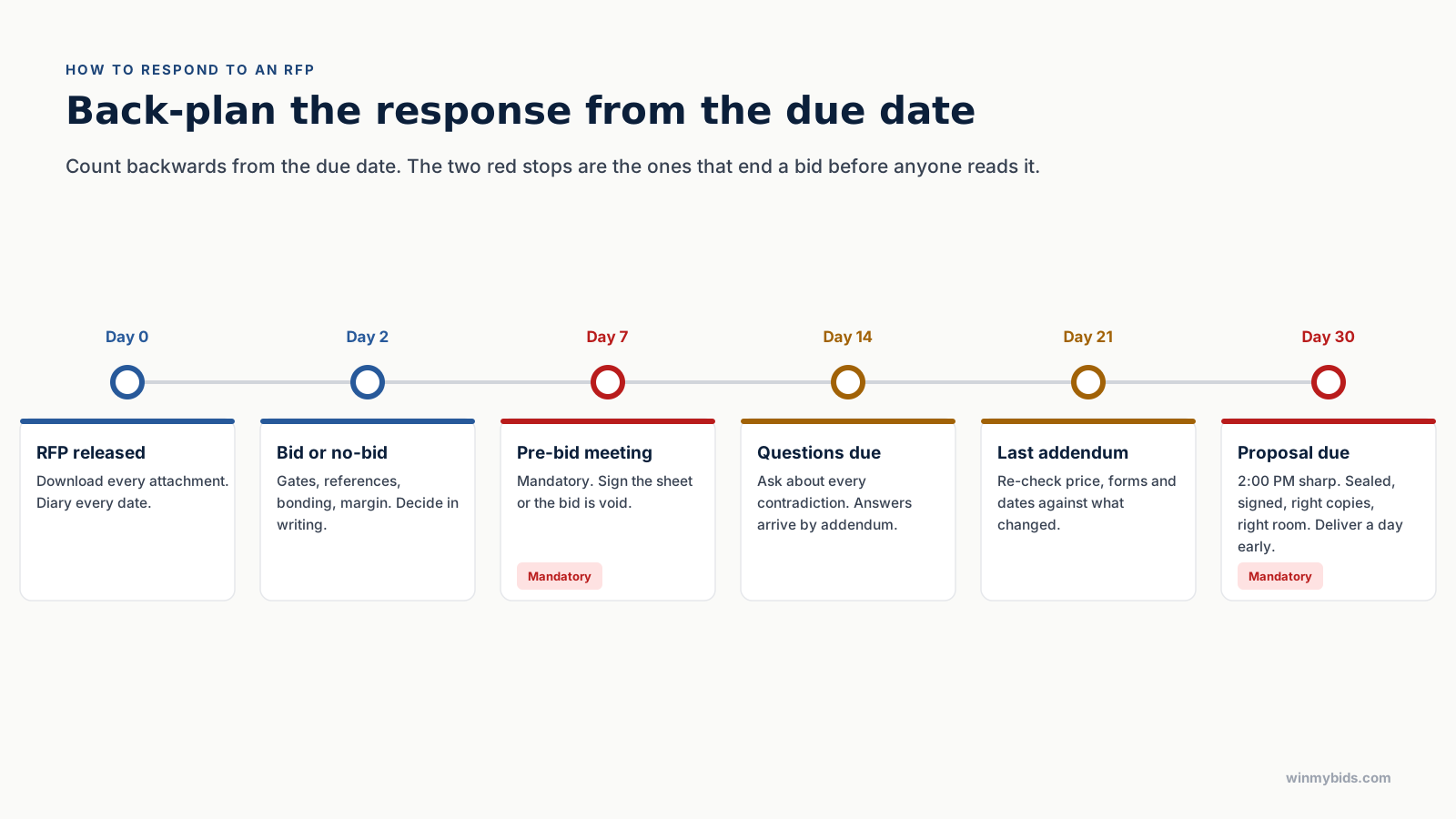
Key takeaways. Read the submission instructions before anything else. Decide bid or no-bid in writing on day two. Put every date on a calendar, including the ones that are not called deadlines. Build the compliance matrix before you write a word. Deliver a day early.
Responding to an RFP is not a writing job. It is a reading job with a writing job at the end. The proposals that get thrown out are rarely the badly written ones; they are the ones that missed a mandatory meeting, skipped a form, or arrived at 2:04 PM. That is good news for a small contractor, because reading carefully is free.
This guide is the order of operations we use, written for the owner of a cleaning, landscaping, security, IT, or trades business who bids on public work without a proposal department.
1. Download everything, then read the submission instructions first
An RFP package is rarely one file. The main solicitation refers to attachments, exhibits, forms, and a price schedule, and those are where the real requirements live. Before you read the scope, make a folder and confirm you have every document the package mentions. If Section 2 refers to "Attachment E, References Form" and there is no Attachment E in the download, that is a question for the buyer today, not the week the bid is due.
Then read the submission instructions, usually in the first two or three pages. You are looking for a short list of facts:
- The due date, the exact time, and the time zone.
- Where the bid goes: an email address, a portal, or a physical room, and whether it must be sealed.
- How many copies, in what format, and whether price goes in a separate envelope.
- Whether a pre-bid meeting or site visit is mandatory.
- The questions deadline and how questions must be sent.
- Every form that must be signed, notarized, or acknowledged.
Write those down in one place. Everything else in the package can be interpreted; this list cannot.
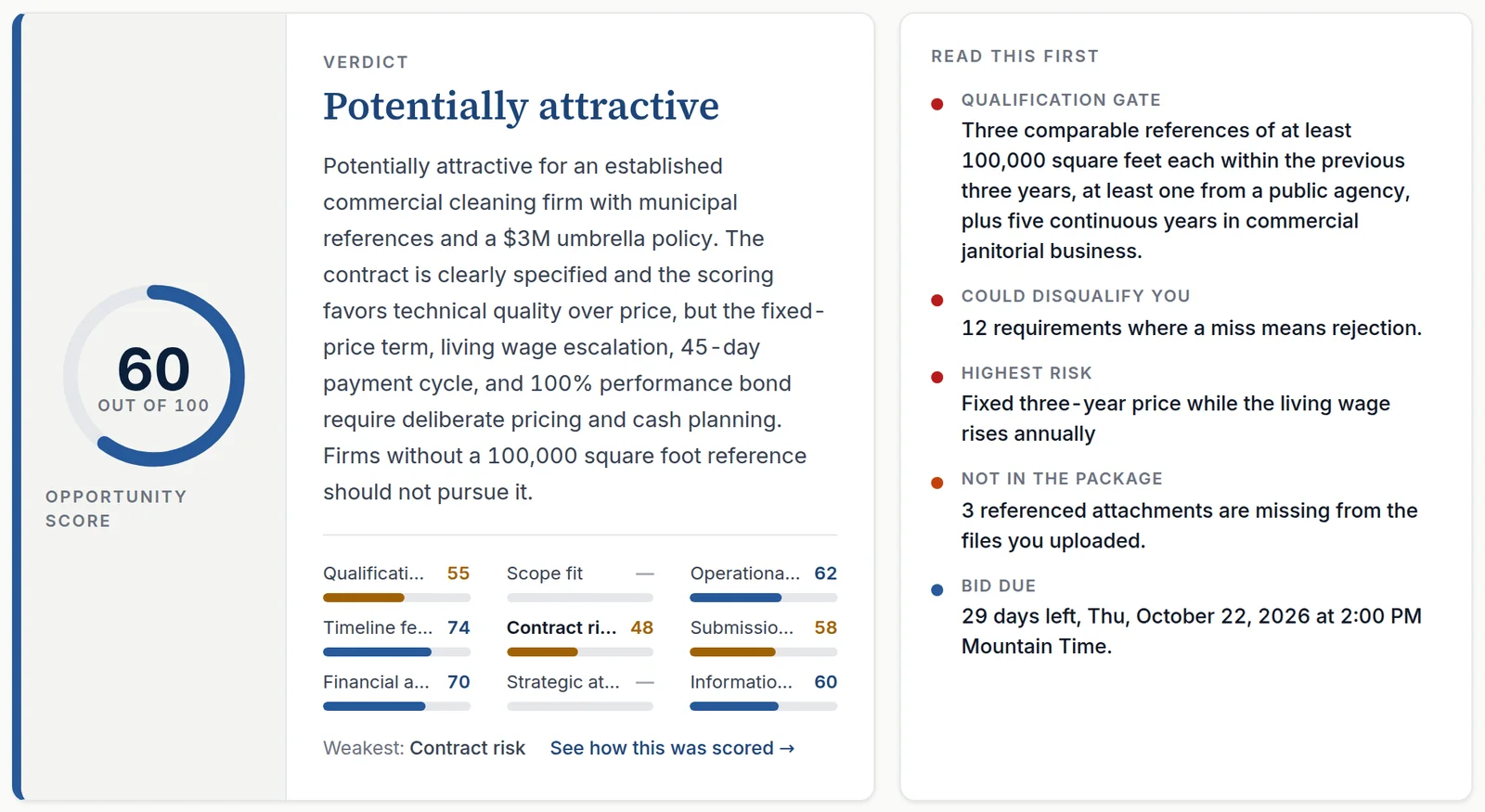
2. Make the bid or no-bid decision on day two
Teams that use a formal bid/no-bid step win a much larger share of what they chase than teams that respond to everything, because they stop spending a week on bids they cannot win. The decision is not about how much you want the work. It is a short list of yes-or-no questions answered from the solicitation itself:
- Can we clear every mandatory gate, including the ones that have already happened?
- Do we hold the references, licenses, certifications, and years in business the buyer requires?
- Can we staff it on the start date, at the wage the package sets?
- Can our balance sheet carry the bonds, the insurance limits, and the payment terms?
- Does the scoring reward what we do well, or is it lowest price wins?
If the answer to the first two is no, stop. We wrote a longer piece on this: Bid or no-bid: the six questions to answer before you chase an RFP.
3. Put every date on a calendar, including the quiet ones
Most packages have four to eight dated events, and only one of them is labeled "due date." The others are the pre-bid meeting, the site visit, the questions deadline, the date answers will be issued, the anticipated award, the contract start, and sometimes a protest window. Any of them can hurt you.
Two of them can end your bid outright: a mandatory pre-bid meeting and the submission deadline. If the meeting is mandatory and you did not sign the attendance sheet, the buyer will reject your proposal as non-responsive no matter how good it is.
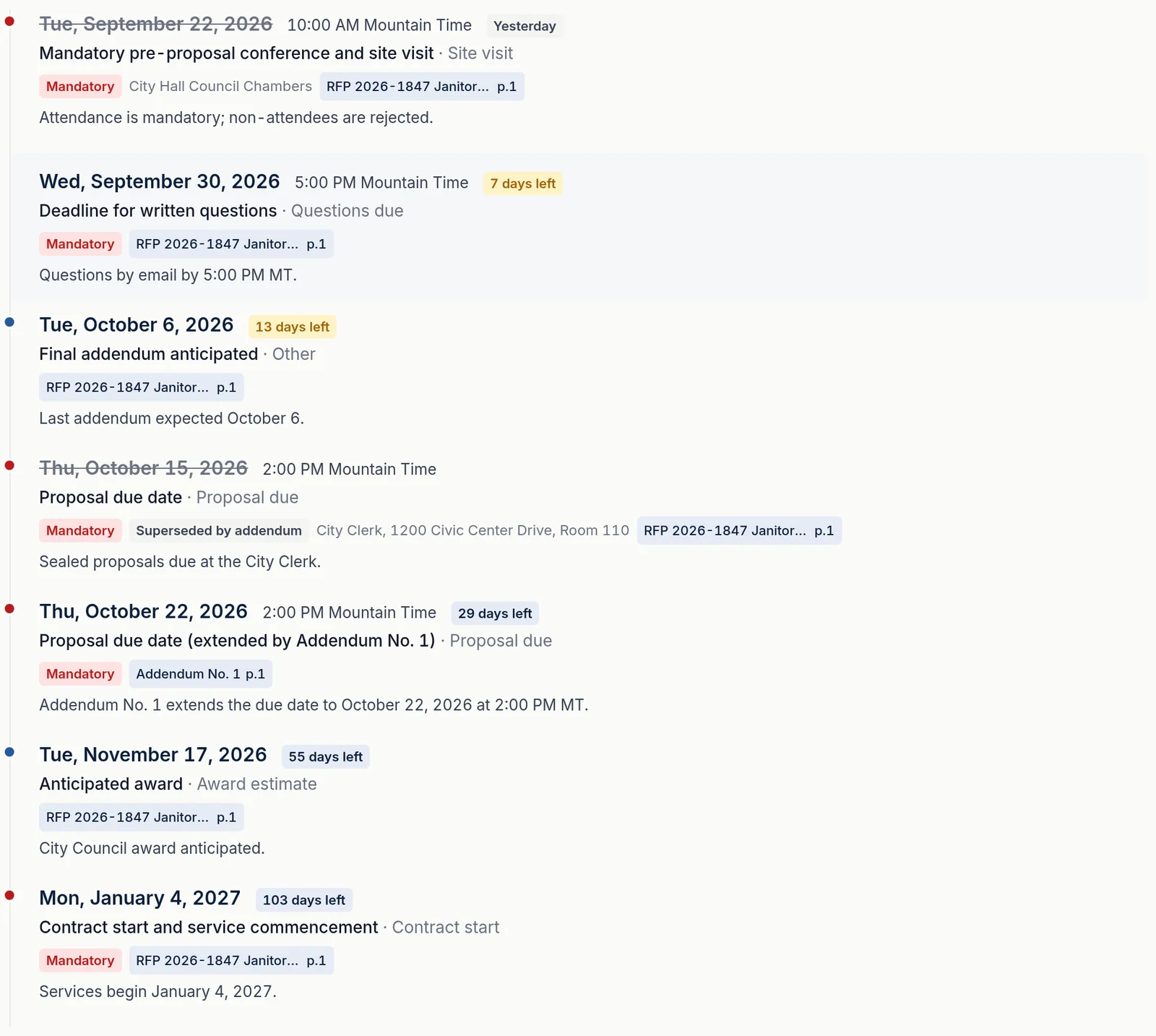
Work backwards from the due date. If proposals are due in thirty days, the questions deadline is usually around day fourteen, the last addendum around day twenty-one, and your internal "pens down" date should be day twenty-eight. Put the physical delivery on the calendar too: a sealed proposal that has to reach a clerk's office in another city needs a courier booked, not a plan to leave early.
4. Build the compliance matrix before you write
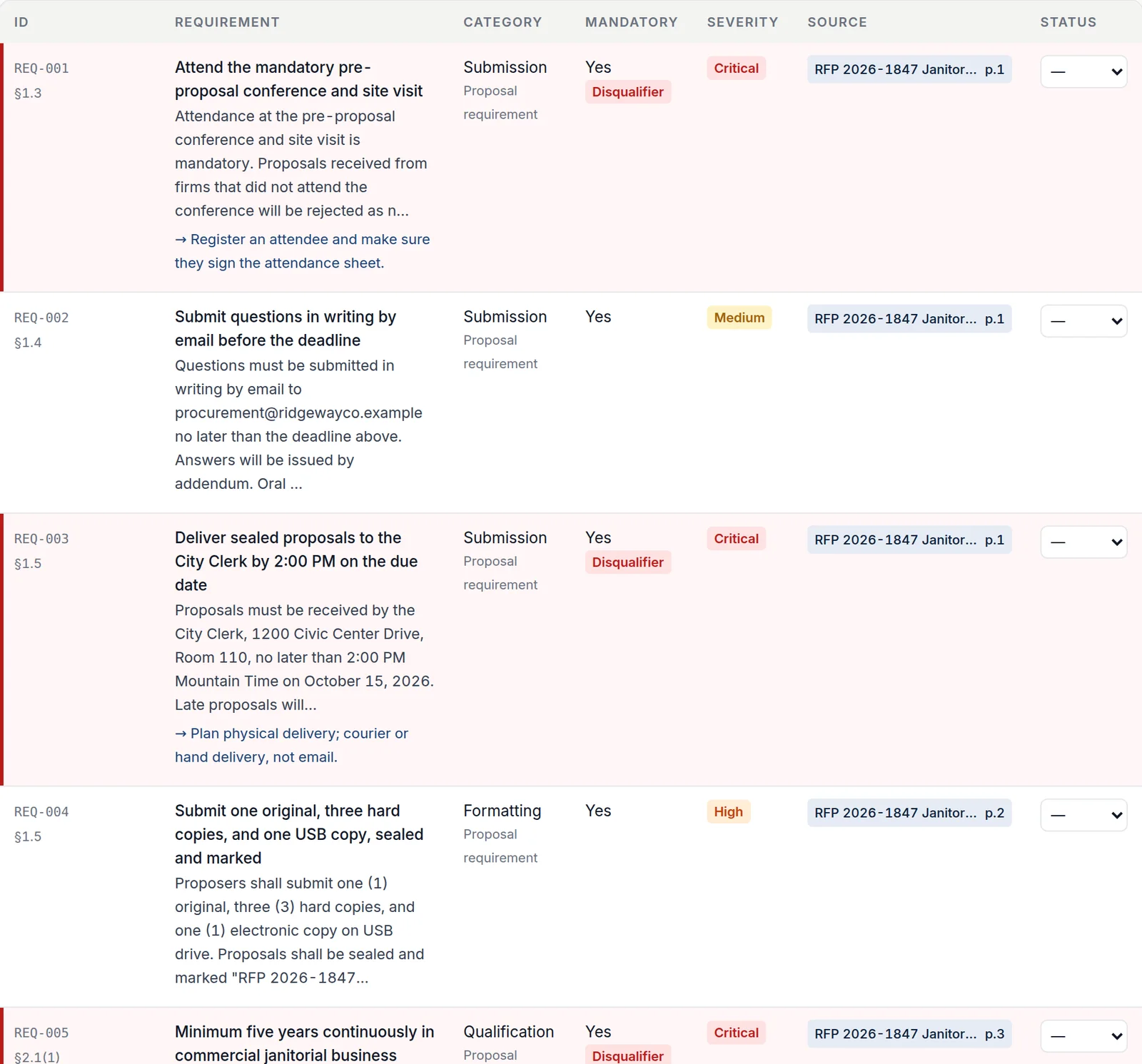
A compliance matrix is a table with one row for every requirement in the package: the buyer's exact words, the section they came from, whether the requirement is mandatory, who on your side owns it, where in your proposal it is answered, and a status. It sounds like overhead. It is the single most effective thing a small bidder can do, because evaluators score against a checklist and your matrix is that checklist from your side of the table.
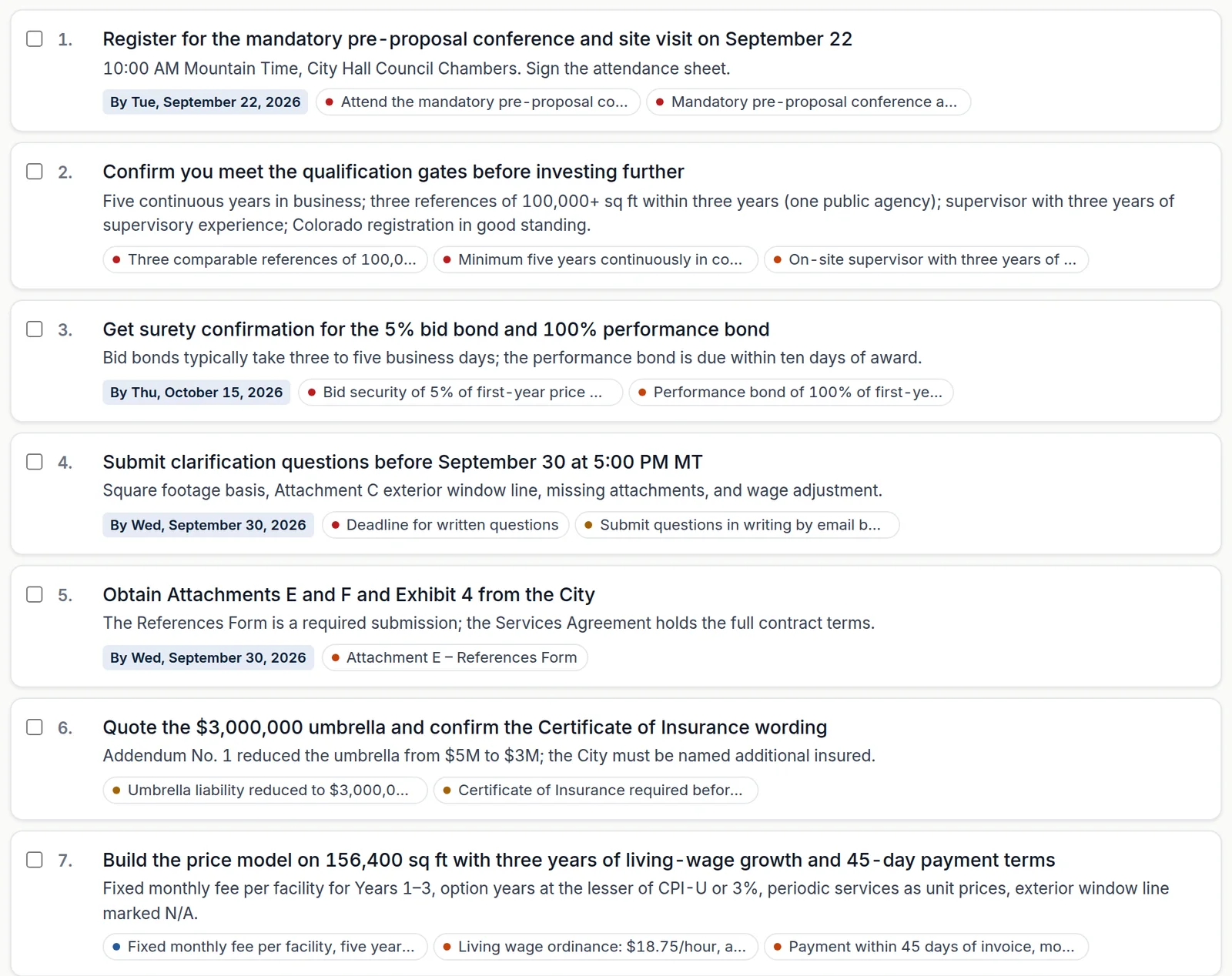
Every "shall," "must," and "will" in the solicitation becomes a row. So does every form and every attachment the buyer expects back. A package with thirty requirements might take an afternoon to extract by hand; this is the part of the process where software earns its keep. WinMyBids builds the matrix from the uploaded package, links each row to the page it came from, and exports it to Excel with owner, status, and response-location columns ready to fill. The compliance matrix guide covers how to build and use one.
5. Ask your questions before the questions deadline
The package will contradict itself somewhere. The scope says 142,000 square feet and the facility schedule totals 156,400. The insurance section wants a $5 million umbrella and an addendum lowers it to $3 million. The price form has a line for work the addendum removed. Each of those is a question, and questions are free right up until the deadline and impossible after it.
Send them in the format the buyer specifies, usually by email to one named person. Ask about anything that changes your price or your ability to comply. Do not ask things the package already answers; it wastes your credibility with the person who will be reading your proposal.
6. Price from the scope, not from a guess
For a service contract, the price is a list: labor hours per site per visit, times the wage the contract sets, plus supplies, equipment, supervision, overhead, bonds, and margin. The pricing instructions tell you the shape the buyer wants: a monthly fee per facility, unit prices for periodic work, option-year pricing, whether escalation is allowed. Price in that shape, on the buyer's form, or the evaluators will not be able to compare you to anyone else.
Read the contract terms as part of pricing. A three-year fixed price against a living wage that rises every January is a margin problem you solve in year-one pricing or not at all. Payment within 45 days of a monthly invoice means your first check arrives about 75 days after you start paying people. If you clean commercial buildings, how to bid on janitorial contracts walks through a per-square-foot price line by line.
7. Write to the evaluation criteria, in their order
Evaluation criteria are the buyer telling you how they will grade the exam. If technical approach is worth 30 points, experience 20, staffing 15, and price 25, write those sections in that order with those headings, and give the 30-point section the most pages. Answer every criterion directly; an evaluator with forty proposals to read will not hunt for your answer.
Stay inside the page limit, use the required fonts and margins, and include the required forms in the required order. Boring wins.
8. Re-check everything after the last addendum
An addendum changes the package. It can move the due date, change the scope, add a form, or reduce an insurance limit, and it almost always requires a signed acknowledgment returned with the bid. After the last one is issued, go back to your day-one list and your matrix and confirm every item is still true. What an addendum changes explains what to look for.
9. Deliver a day early
Late is late. A clerk who stamps your envelope at 2:01 PM will not open it. Deliver the day before, get a receipt, and keep it. If submission is electronic, upload the day before and confirm the portal shows the right files; portals slow down in the last hour and that is not the buyer's problem.
Questions people ask
How long does it take to respond to an RFP? A small contractor with a clear process spends two to four working days on a straightforward service bid, spread across the response window. Most of the elapsed time is waiting: for the site visit, for answers to questions, for the last addendum.
What is the most common reason RFP responses are rejected? Non-compliance with the submission instructions: late delivery, a missing mandatory form or acknowledgment, not attending a mandatory meeting, or price submitted in the wrong place. Content quality is usually the second cut, not the first.
Should I respond to every RFP I qualify for? No. Respond to the ones where you clear every gate, the scoring rewards your strengths, and the contract terms fit your balance sheet. A written bid/no-bid decision takes an hour and saves weeks.
Where should I start with a new package? Upload it. A free preview from WinMyBids returns the deadlines, the required forms, and a sample of the requirements in about a minute, linked to their pages. The full report adds the compliance matrix, risks, contradictions, questions to ask, and an action plan. See a complete sample report before you decide.
Bidding on an RFP right now?
Upload the package and get every deadline, requirement, and form linked to its page, free, before you decide to buy the report.
Analyze an RFP, free preview first