Bid or No-Bid: Six Questions to Answer Before You Chase an RFP
· Bid strategy, RFP response, Government contracts
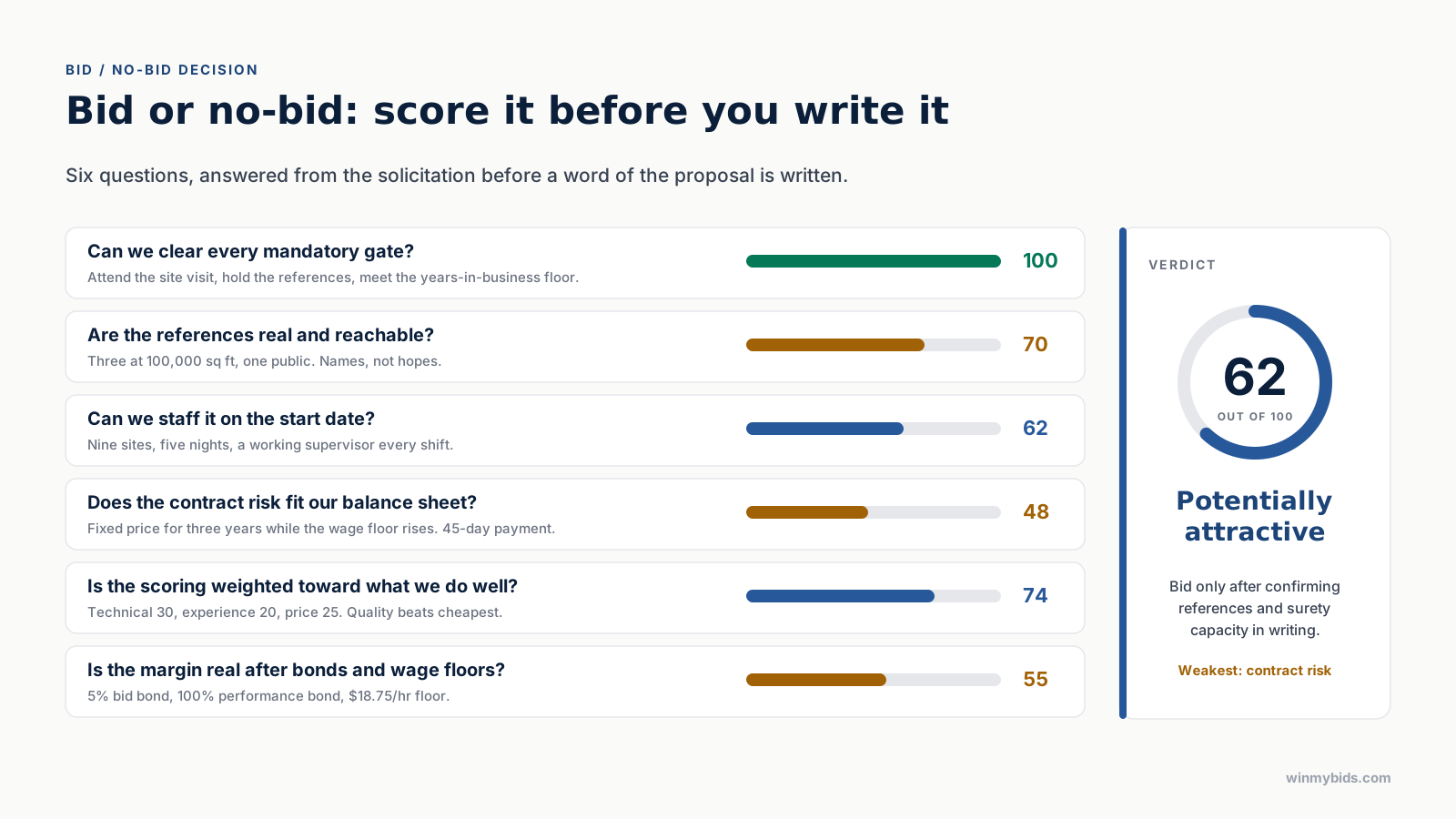
Key takeaways. Decide in writing, on day two, from the package alone. Gates you cannot clear end the discussion. Score the rest so two people can disagree about a number instead of a feeling. A walk-away is a win when it saves the week.
Every contractor who bids public work has a story about the proposal that took a week, scored well, and lost to the incumbent by two points. Fewer tell the story about the proposal that was rejected unopened because nobody attended the site visit. Both are bid/no-bid failures. The first is a judgment call that went the wrong way; the second was knowable on day one.
A bid/no-bid decision (some teams call it go/no-go) is a short, written evaluation of whether to spend the time to respond at all. Teams that do it consistently report win rates two to three times higher than teams that chase everything, not because their proposals get better but because they stop writing the ones that were never going to win.
Here are the six questions, in the order that ends the conversation fastest.
1. Can we clear every mandatory gate?
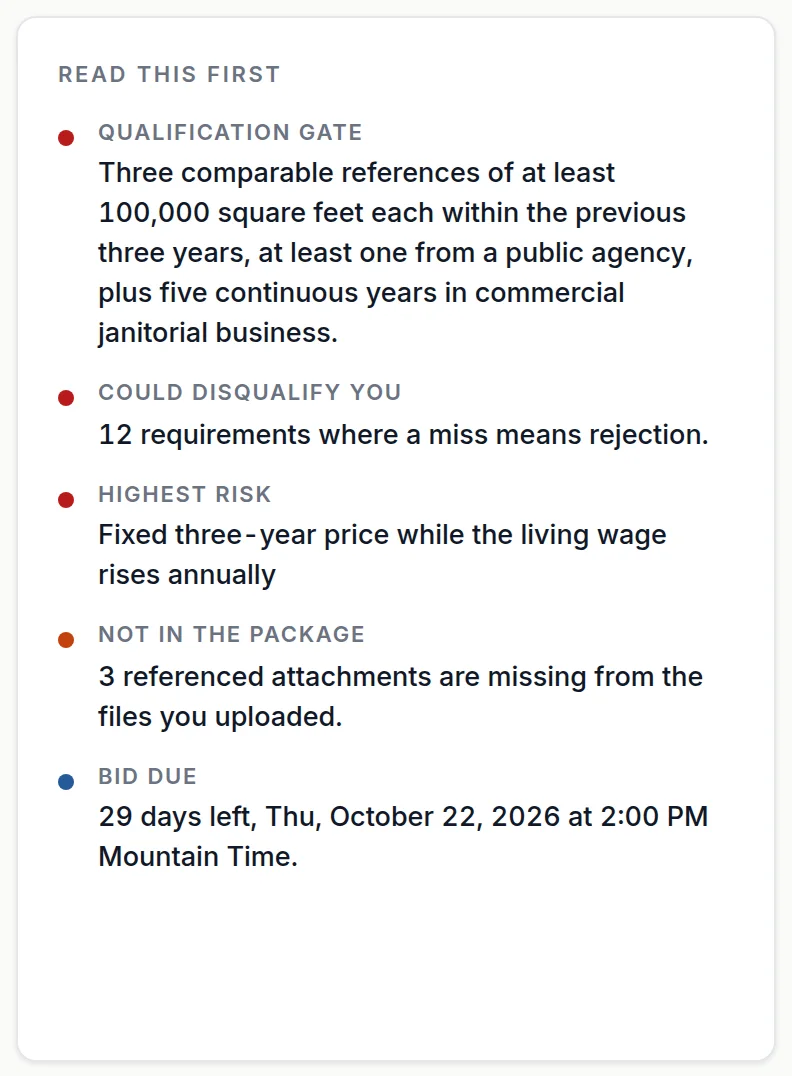
Gates are the requirements where a miss means rejection, not a lower score: a mandatory pre-proposal conference, a site visit, a license, a certification, a minimum number of years in business, a bid bond, a specific insurance limit. They are usually stated with the word "shall" and often with the phrase "will be rejected as non-responsive."
Find them all before you do anything else. If one has already happened, such as a mandatory meeting last Tuesday, the decision is made for you. If one is coming, put it on the calendar now.
2. Do we actually hold the references and qualifications?
"Three comparable references of at least 100,000 square feet within the previous three years, at least one from a public agency" is a sentence that quietly excludes most small cleaning companies. So is "five continuous years in commercial janitorial business" or "a supervisor with three years of supervisory experience on contracts of similar size."
The test is not whether you could describe yourself that way. It is whether you can write down three names, three phone numbers, and three contract values today, and whether those people will pick up the phone for a buyer. If you cannot, this is a no-bid, and it is not a writing problem you can fix with a better cover letter.
3. Can we staff it on the start date?
A contract that starts January 4 with nine buildings, five nights a week, a working supervisor on every shift, and a two-hour emergency response across all sites is a hiring plan, not a proposal. Count the heads. Check the wage the contract sets against what you pay now. If the package includes a living wage or prevailing wage floor, that is the number, and it will rise on a schedule the package also states.
Say no if the honest answer is "we would figure it out after award." Buyers have seen that answer fail and they write contract terms, such as liquidated damages per missed night, specifically for it.
4. Does the contract risk fit our balance sheet?
This is the question small businesses skip, and it is the one that turns a won contract into a bad year. Read the contract terms as a lender would:
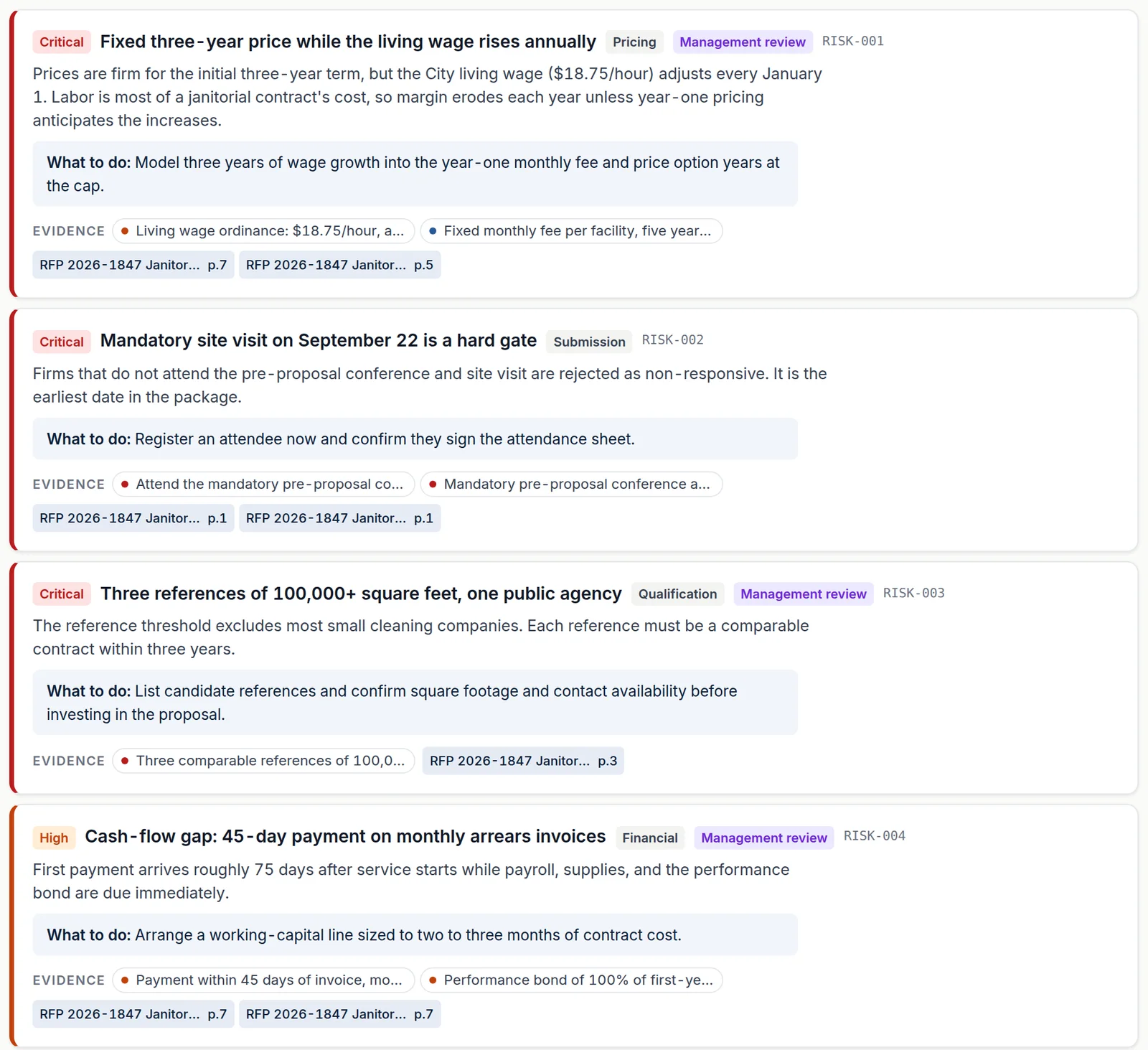
- Bonds. A 5% bid bond with the proposal and a 100% performance bond within ten days of award both consume bonding capacity. Ask your surety before you bid, in writing.
- Payment terms. Net 45 on monthly invoices in arrears means the first payment arrives around day 75. Payroll does not wait.
- Fixed price against rising cost. Prices firm for three years while the wage floor adjusts every January is a margin that shrinks on a schedule. Either year-one pricing carries the increases, or the margin is fiction.
- Liquidated damages and termination. $250 per facility per missed night, and termination for convenience on thirty days' notice with no claim for anticipated profit, change what "fixed cost" means.
None of these are reasons not to bid. They are reasons to price correctly, and reasons to walk away if the price the market will pay does not cover them.
5. Is the scoring weighted toward what we do well?
The evaluation criteria tell you what kind of competition this is. Technical approach 30, experience 20, staffing 15, price 25, interview 10 is a quality competition where a thorough, specific proposal from a well-run small firm can beat a cheaper incumbent. Price 70, everything else 30 is a price competition, and you should only enter it if your cost structure is genuinely lower.
If weights are not published, assume a qualitative evaluation and do not assume price dominates. If the buyer will hold interviews or presentations, plan for them; they are often where the award is decided.
6. Is the margin real after the package is done with it?
Take your normal margin and subtract what the package costs you: the bond premiums, the insurance increase to meet the required limits, the supervisor the spec adds, the certified chemicals, the wage floor, the cash-flow gap, the annual increases you cannot pass through. What is left is the margin you are bidding for. If it is under your floor, this is a no-bid, however attractive the top-line number looks.
Scoring it
Give each question a score from 0 to 100 and write one sentence of evidence next to it, citing the section of the package. The questions are not equal: a gate you cannot clear is a zero that ends the exercise, and the others are judgment. The score is less important than the sentences, because the sentences are what you will argue about, and arguing about evidence is the point.
WinMyBids does this from the package itself. The report scores nine dimensions, including qualification fit, timeline feasibility, contract risk, submission burden, and financial attractiveness, and the headline band follows the weakest dimension when it falls below 40, so a single disqualifier cannot hide behind a good average. Each dimension shows its rationale, its primary concern, and the findings behind it. The sample report shows the whole scorecard for a fictional city janitorial RFP, and the free preview of any package shows the gates before you pay for the full report.
When to walk away
Walk away when a gate is closed, when the references are not real, when the start date cannot be staffed, or when the margin after risk is below your floor. Walk away early, in writing, and keep the note; the same buyer will issue the same solicitation again in three years, and you will want to remember why.
Stay in when the gates are open, the scoring rewards what you do well, and the contract terms are survivable at a price the market pays. Then go build the compliance matrix. How to respond to an RFP picks up from there.
Questions people ask
How long should a bid/no-bid decision take? One to two hours for a standard service solicitation, once you have the package in front of you. Most of that is finding the gates and the contract terms, which are scattered across the main document and the attachments.
Who should be in the room? Whoever will sign the contract and whoever will staff it. For a small firm that is often the same person, plus the surety or insurance agent on the phone for the bonding and limits questions.
What if we are on the fence? Ask the buyer your questions before the questions deadline and decide after the answers. Contradictions in the package, such as two different square footage totals, are legitimate reasons to wait for an addendum.
Bidding on an RFP right now?
Upload the package and get every deadline, requirement, and form linked to its page, free, before you decide to buy the report.
Analyze an RFP, free preview first