RFP Addenda Explained: What Changes, What You Must Acknowledge, and How to Re-Check Your Bid
· RFP addendum, Bid compliance, RFP response
Key takeaways. An addendum is part of the solicitation; the version without it no longer exists. Acknowledge every one, in the way the package specifies. After each addendum, re-check the dates, the scope you priced, the forms list, and the insurance and bonding requirements. The last addendum is when most bids quietly go wrong.
An addendum (some buyers say amendment or modification) is a formal change to a solicitation issued before the due date. Buyers issue them to answer bidders' questions, fix errors, extend deadlines, change scope, add or replace forms, and adjust requirements such as insurance limits. A package with no addenda is unusual; two or three is normal; a large or badly drafted package can have ten.
The mistake small bidders make is treating an addendum as a notice. It is a rewrite. The document you priced last week is not the document you are bidding on this week.
What addenda usually change
Dates. The most common change is an extended due date, often because the questions deadline produced questions the buyer needs time to answer. Sometimes the site visit moves, or a second one is added. Sometimes the questions deadline itself is extended, which reopens your chance to ask.
Scope. Answers to questions frequently narrow or expand the work: a service removed, a building added, a frequency changed, a square footage corrected. Any of these changes your price. A corrected square footage that the buyer forgets to carry into the original section of the RFP creates a contradiction you must price around and should ask about.
Forms. Addenda add forms (a transition plan, a subcontractor list), replace forms (a corrected price proposal form with different lines), and sometimes remove them. A replaced price form is the one that catches people: pricing on the superseded version is a defect.
Requirements. Insurance limits go down more often than up, because bidders ask. Bonding percentages, page limits, reference thresholds, and staffing requirements all get adjusted by addendum.
Answers to questions. The addendum that publishes all bidders' questions and the buyer's answers is the most valuable document in the package. Read every question, not just yours; competitors' questions tell you what they are worried about, and the buyer's answers are binding.
The acknowledgment is a rejection-grade requirement
Nearly every public solicitation requires bidders to acknowledge receipt of each addendum, either on a form returned with the bid, on the bid form itself, or by returning a signed copy of the addendum. The purpose is legal: the buyer needs evidence that your offer was made on the current package.
An unacknowledged addendum is one of the most common reasons bids are rejected as non-responsive, and the rejection is nearly automatic, because accepting your bid would let you argue later that you never agreed to the change. Put the acknowledgment on your required-documents list the day each addendum arrives. Why bids get rejected covers the rest of that list.
The re-check, after every addendum
Run this after each addendum, and all of it again after the last one.
- Dates. Did the due date, the questions deadline, or a site visit move? Update the calendar and the courier booking.
- Scope you priced. Did any quantity, frequency, location, or service change? Reprice the affected lines. If the addendum corrected a number in one place but not another, note which one you used and ask.
- Forms. Was any form added, replaced, or removed? Print the new version, retire the old one, and update your required-documents list.
- Requirements. Did an insurance limit, bond, page limit, or qualification change? Your certificate of insurance, your surety, and your compliance matrix all change with it.
- Contradictions. Does the addendum now disagree with the original package anywhere? These are your last questions, if the questions deadline is still open, or a stated assumption in your bid if it is not.
- Acknowledgment. Signed, on the right form, in the submission package.
An example of what one addendum does
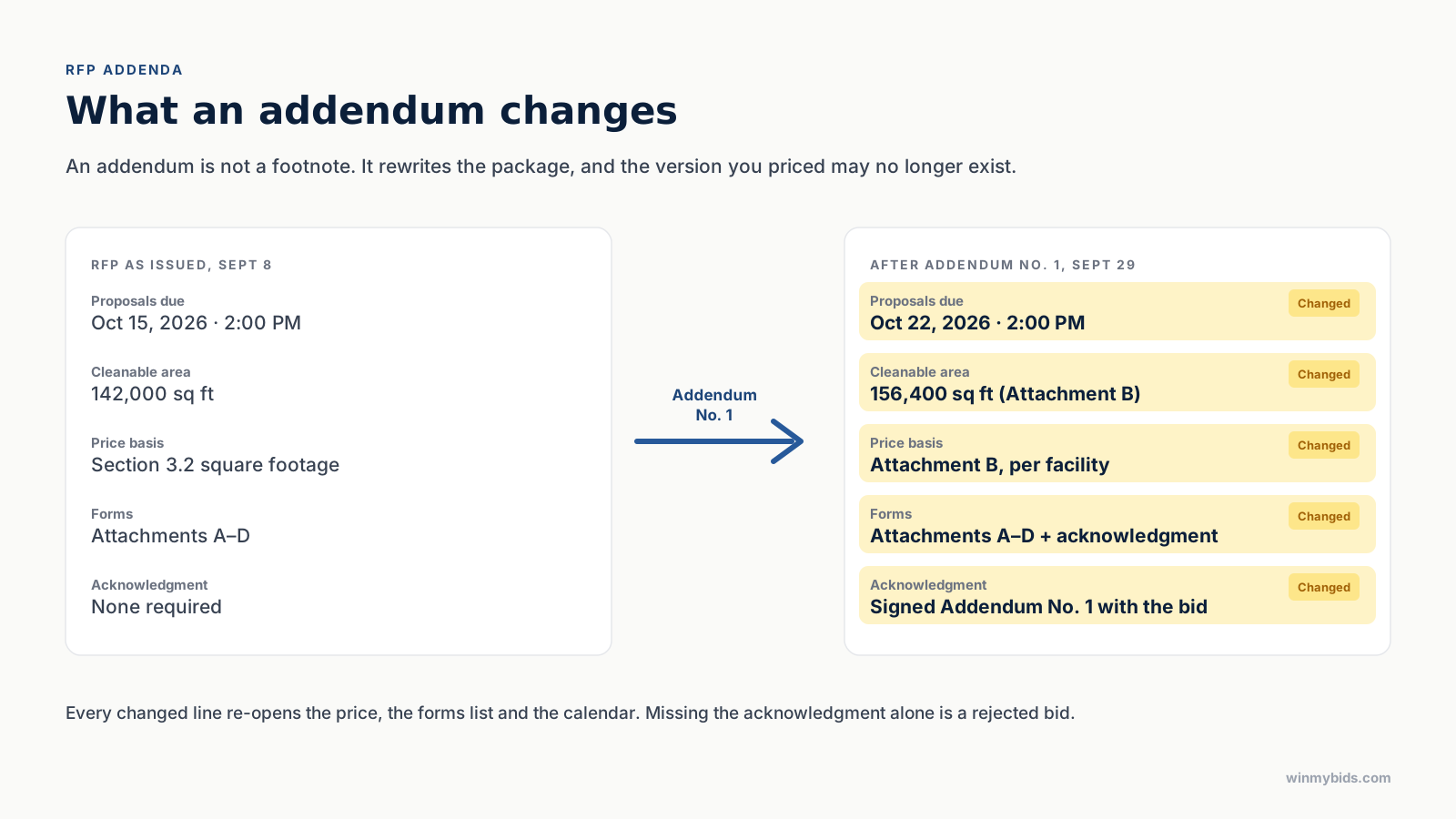
Take a fictional city janitorial RFP issued September 8. Addendum No. 1 arrives September 29 and does five things: extends the due date a week, instructs bidders to price on the facility schedule's 156,400 square feet instead of the RFP's 142,000, reduces the umbrella liability requirement from $5 million to $3 million, removes exterior window cleaning from scope, and adds a one-page transition plan to the required submissions.
Every one of those touches the bid. The calendar changes. The price changes by ten percent of square footage. The insurance certificate can be cheaper, but must show the city as additional insured at the new limit. The price form still has an exterior window line, which must now be marked not applicable with a note. A new document must be written. And the addendum itself must be signed and returned.
A bidder who read the addendum as "due date moved to the 22nd" would submit a bid priced on the wrong square footage, with the wrong insurance certificate, a stray price line, a missing form, and no acknowledgment.
How WinMyBids handles addenda
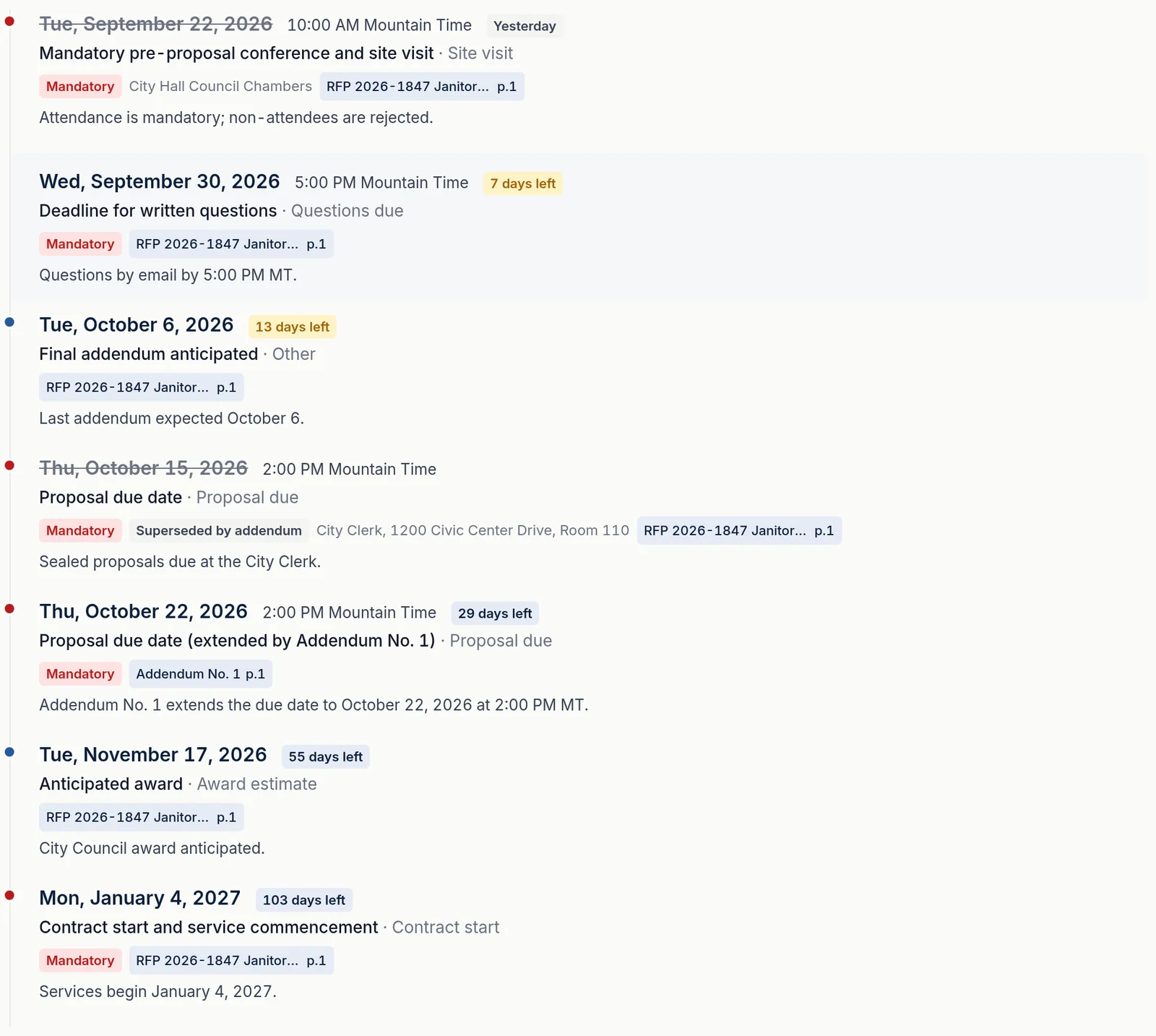
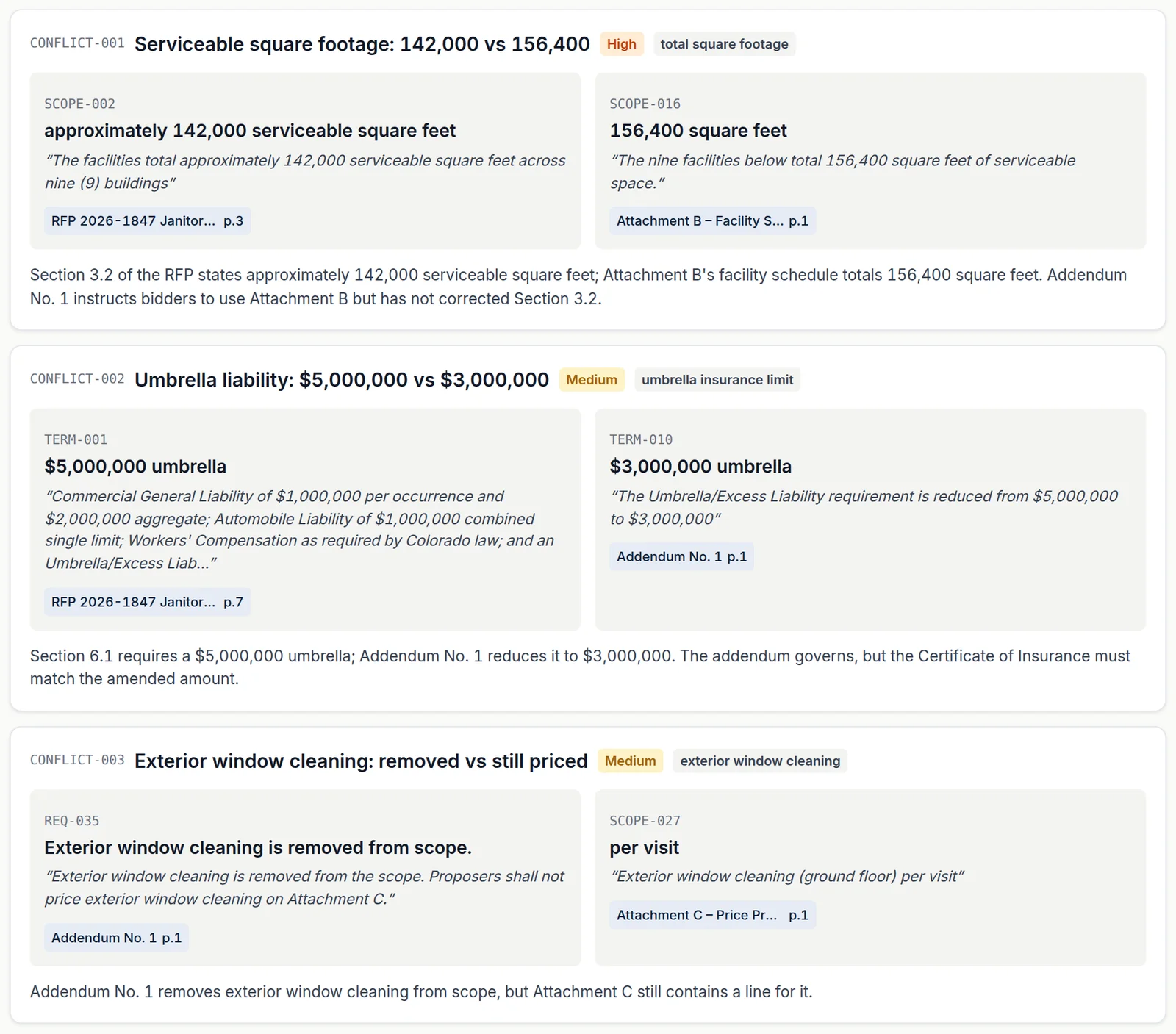
Upload the addendum to the same package and the report is re-run against the full set. Dates the addendum superseded are marked and struck through, with the new date carrying its own countdown. Contradictions between the addendum and the original package are shown side by side, each with its source passage. Requirements the addendum added appear in the matrix with the addendum as their source, and forms it added appear in the required-documents list. The report includes one addendum re-run; the report and Bid Pricing bundle includes two. See the pricing, or look at the sample report, which includes an addendum.
Questions people ask
What is the difference between an addendum and an amendment? Vocabulary. Federal solicitations say amendment (SF-30 for contracts); state and local buyers usually say addendum. Both are formal changes that become part of the solicitation.
Do I need to acknowledge an addendum that only answers questions? Yes, if the package requires acknowledgment of all addenda, which it almost always does. The answers are binding on the buyer and on you.
What if an addendum arrives the day before the deadline? Read it immediately, run the re-check, and acknowledge it. If it changes your price and there is no time to reprice, that is a reason to ask for an extension in writing, and buyers often grant one when a late addendum changes scope.
Can I bid on the original package if I disagree with the addendum? No. The addendum is the package. Bids on the superseded version are rejected.
Bidding on an RFP right now?
Upload the package and get every deadline, requirement, and form linked to its page, free, before you decide to buy the report.
Analyze an RFP, free preview first