Why Bids Get Rejected as Non-Responsive (and the Ten-Minute Check That Prevents It)
· Bid compliance, RFP response, Government contracts
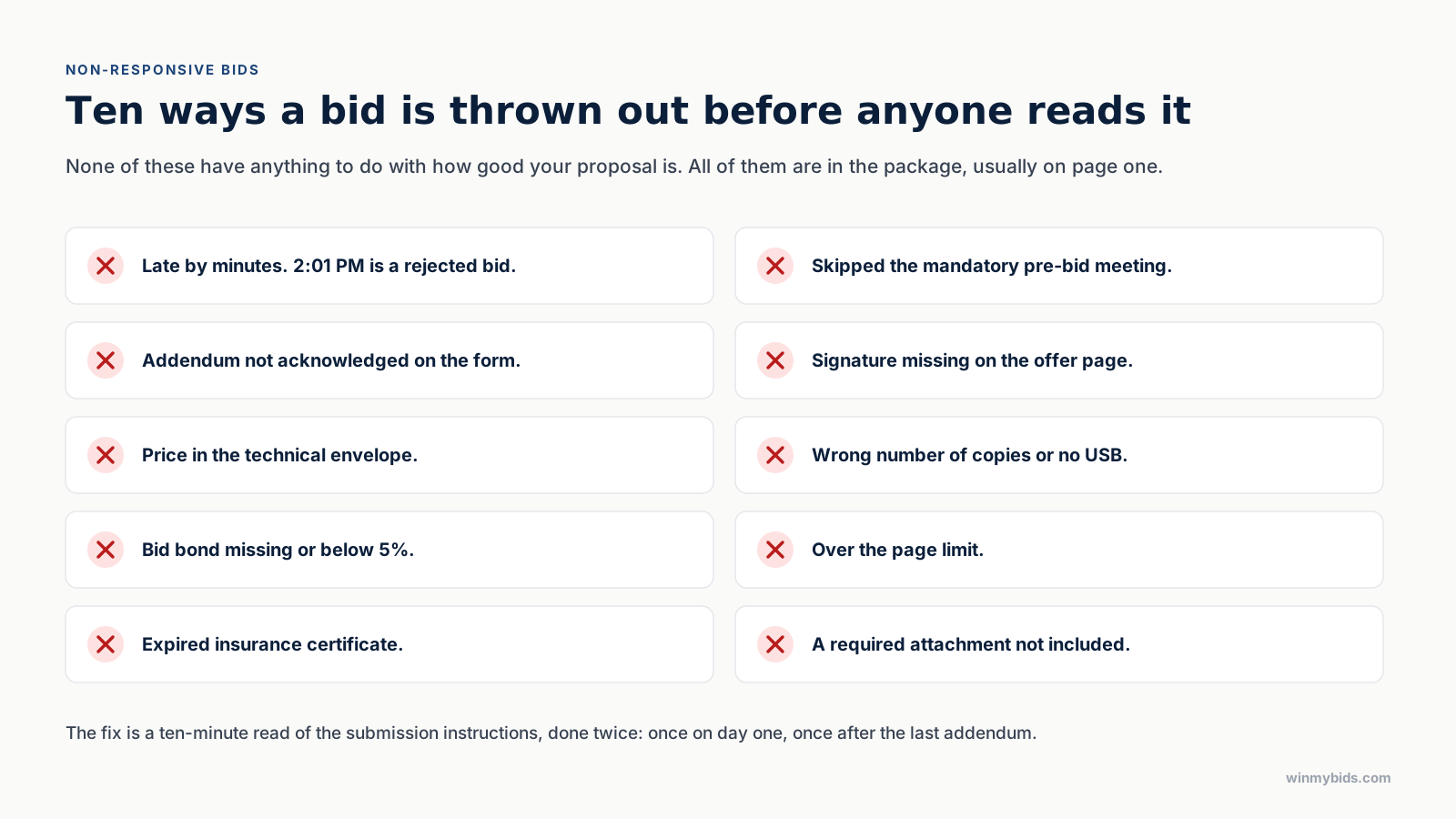
Key takeaways. "Non-responsive" means the bid failed the buyer's checklist before scoring started. The causes are administrative, knowable on day one, and unrelated to quality. Do the ten-minute check twice: on day one and after the last addendum.
When a public buyer rejects a bid as non-responsive, it means the bid did not follow the submission rules, so the evaluators never scored it. The buyer is usually required to reject it; a purchasing officer who accepts a late or incomplete bid from one firm exposes the agency to a protest from every other bidder. There is no discretion and there is no appeal that works.
That is the frustrating part and the useful part. Frustrating, because the work is wasted. Useful, because every cause is written in the package, usually in the first three pages, and every one is preventable in minutes.
The ten ways it happens
1. Late. Two o'clock means two o'clock. A clerk who stamps the envelope at 2:01 PM logs it as late and returns it unopened. Electronic portals close on the second and slow down in the last hour. Deliver or upload the day before.
2. The mandatory meeting. If the pre-bid conference or site visit is mandatory, attendance is a requirement, and the sign-in sheet is the evidence. Firms that did not sign are rejected regardless of what the proposal says. This is the only cause on the list that can already have happened by the time you open the package.
3. Addendum not acknowledged. Nearly every public solicitation requires bidders to acknowledge each addendum, either on a form returned with the bid or by signing the addendum itself. An unacknowledged addendum is treated as a bid on a package that no longer exists.
4. Unsigned offer. The bid form, the offer page, or the cover letter has a signature line, and an unsigned bid is not an offer. Wet signature where required; the right officer where specified.
5. Price in the wrong place. When the package asks for the price proposal in a separately sealed envelope, price anywhere else is a defect, because evaluators must score technical merit without seeing price. The reverse happens too: a technical volume that references pricing.
6. Wrong copies, wrong format. One original, three hard copies, and one USB means exactly that. So does the page limit, the font size, the margins, and the file format the portal accepts. Formatting rules are rejection-grade more often than bidders expect.
7. Bid bond missing or short. A 5% bid security is a mandatory attachment. A bond from an unlicensed surety, for less than the stated percentage, or made out to the wrong entity fails.
8. Over the page limit. Twenty-five pages excluding the cover letter and required forms is a rule. Some agencies stop reading at page 26; others reject.
9. Expired or wrong insurance evidence. If a certificate of insurance is required with the bid, it must show the required limits, name the buyer as additional insured where required, and be current. A certificate showing last year's $5 million umbrella when the addendum required $3 million with the agency named is a question at best.
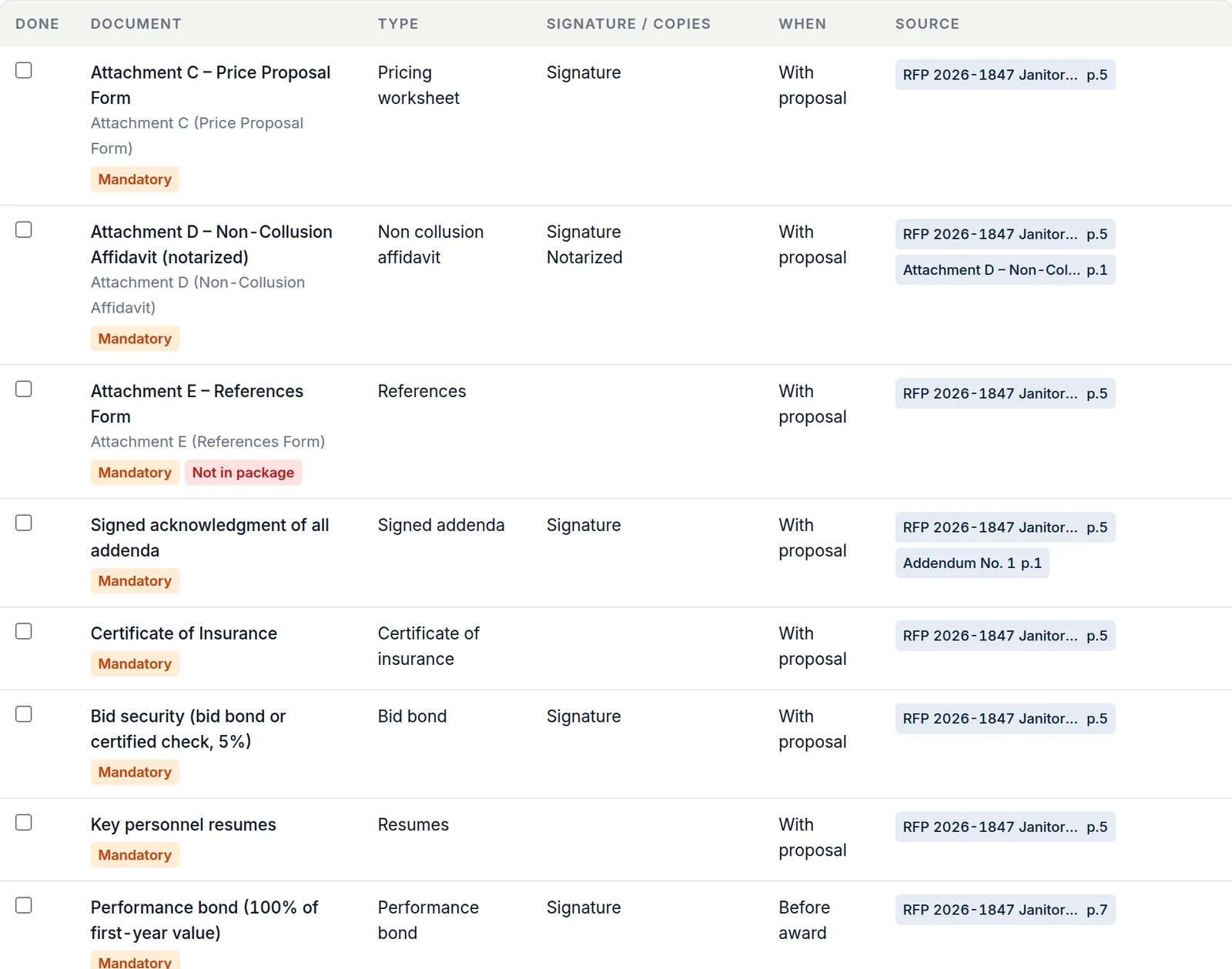
10. A required attachment not included. The references form, the non-collusion affidavit (notarized), the conflict-of-interest statement, the subcontractor list, the transition plan an addendum added. Any required attachment left out is a defect, and the ones that were added late are the ones that get missed.
Why it is almost always administrative
Content problems, such as a weak technical approach or thin experience, cost points. Administrative problems cost the bid. Buyers design it that way: responsiveness is a pass/fail gate applied before any judgment, so it can be applied identically to every bidder.
That also means the fix is not a better writer. It is a list, checked twice. If you keep a compliance matrix, the list is the mandatory rows filtered out of it.
The ten-minute check
Do this on day one, when you first open the package, and again after the last addendum, because addenda change the list.
- Due date, time, time zone, and delivery location or portal. On the calendar, with the courier booked.
- Mandatory meetings and site visits. Attended, or scheduled with a named attendee.
- Every addendum acknowledged, on the form the package specifies.
- Signature lines found and assigned to the right officer.
- Price proposal location: separate envelope or separate file, and nothing about price elsewhere.
- Copy count, format, page limit, font, margins.
- Bid security: amount, surety, payee, and attached.
- Insurance evidence: limits, additional insured wording, dates.
- Every required attachment listed and in the file, including the ones addenda added.
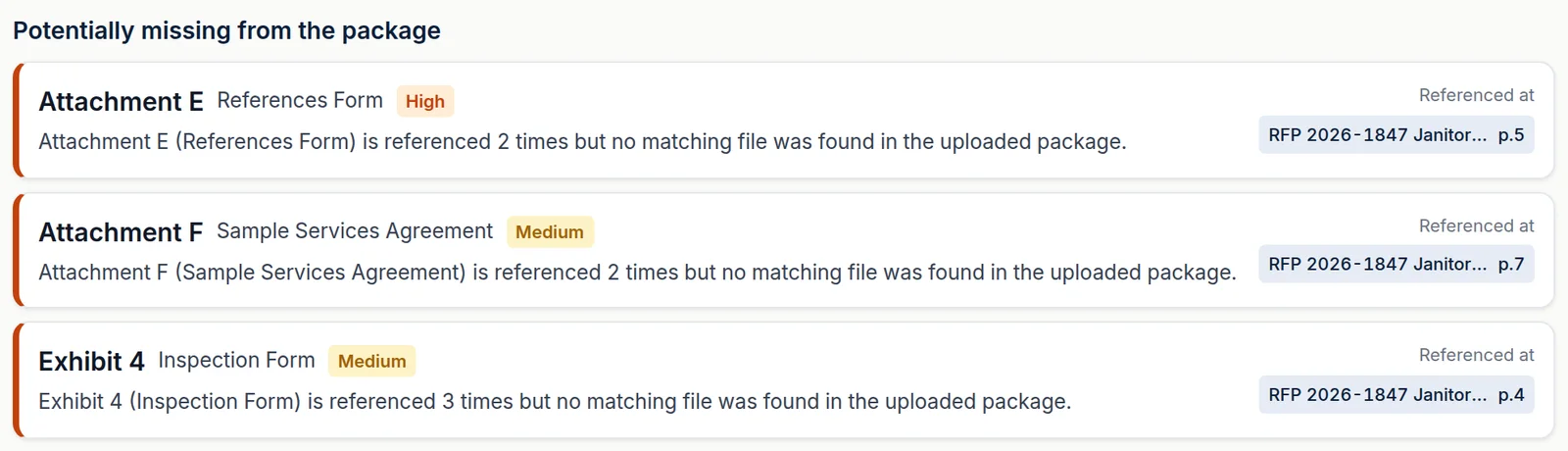
- Attachments the package references that you never received. Ask for them before the questions deadline; a form you never got is still a form you must return.
Where software helps and where it does not
The check is a reading task, and reading a 40-page package with five attachments for every "shall" is where people miss things at 11 PM. WinMyBids reads the uploaded package and puts the submission rules at the top of the report: the due date with a countdown, whether the meeting is mandatory, every required document with its signature and notarization requirements, and the attachments the package references but does not contain. Each item links to the page it came from, so you can check the wording yourself.
What it cannot do is sign the form, book the courier, or attend the site visit. The check is still yours. The free preview shows the deadlines and the forms for any package; the sample report shows the full list for a fictional city RFP.
Questions people ask
Can a buyer waive a minor irregularity? Many public agencies reserve the right to waive informalities that do not affect price, quality, or fairness, such as a missing page number. Late delivery, a missing bid bond, and an unacknowledged addendum are almost never treated as minor. Do not plan on a waiver.
Can I fix a defect after the deadline? Usually not. Some agencies allow clarification of an ambiguous submission, but not the addition of a missing form or signature, because that would be a new offer after the deadline.
Is a proposal rejected for going over the page limit? It depends on the agency. Some stop reading at the limit, some reject, some deduct. Treat the limit as a hard rule.
What if the package itself is missing a form it requires? Ask the buyer in writing before the questions deadline and keep the answer. If the form never arrives, note in your submission that it was requested and not provided. How to respond to an RFP covers the questions process.
Bidding on an RFP right now?
Upload the package and get every deadline, requirement, and form linked to its page, free, before you decide to buy the report.
Analyze an RFP, free preview first